California AB 1154 Explained - New Rules Make Junior ADUs Easier To Build
Learn how California's AB 1154 simplifies rules for JADUs and small ADUs, making it easier and faster to build affordable housing on your property.
California's AB 1154, signed into law by Governor Newsom in October 2025, is a game-changer for homeowners looking to build junior accessory dwelling units (JADUs) and small ADUs.
The new law simplifies confusing rules, creates unified standards, and removes barriers that previously slowed down or blocked legally valid projects.
The timing couldn't be more relevant. LA County public permitting records show that 601 JADU permits have been filed countywide, growing from zero pre-2020 to approximately 137 per year by 2022–2023.
Despite that momentum, JADUs still represent only 3–4% of all ADU applications, suggesting enormous untapped potential that AB 1154 is designed to unlock.
Here's what you need to know about AB 1154 and how it can help you add a JADU to your property.
What you'll learn:
- How AB 1154 clarifies the rules for JADUs and small ADUs under 500 square feet.
- Key changes to owner-occupancy, permitting, and unit definitions under the new junior ADU rules.
- Why JADUs matter for California's housing crisis.
- How to determine whether a JADU or detached ADU is right for your property.
- How LA County permit data shows JADU adoption growing from zero pre-2020 to 137 applications per year and what that trend means for homeowners considering a project now.
- How to get started with a JADU project step by step.
Book a free site visit with LADU today, and let's see what's possible.
What Is AB 1154?
AB 1154, authored by Assemblymember Juan Carrillo and sponsored by California YIMBY, addresses a long-standing problem in California's ADU laws: the overlapping and sometimes contradictory rules governing small ADUs and Junior ADUs.
Before AB 1154, homeowners and local planning departments often struggled with:
- Confusing definitions of what qualified as a JADU vs. a small ADU.
- Inconsistent standards across different code sections.
- Slower approvals due to uncertainty about which rules applied.
- Occasional denials of projects that should have been approved.
AB 1154 fixes these issues by creating a more unified set of standards for ADUs under 500 square feet, giving homeowners clearer guidance and faster approvals.
What Is a Junior ADU (JADU)?
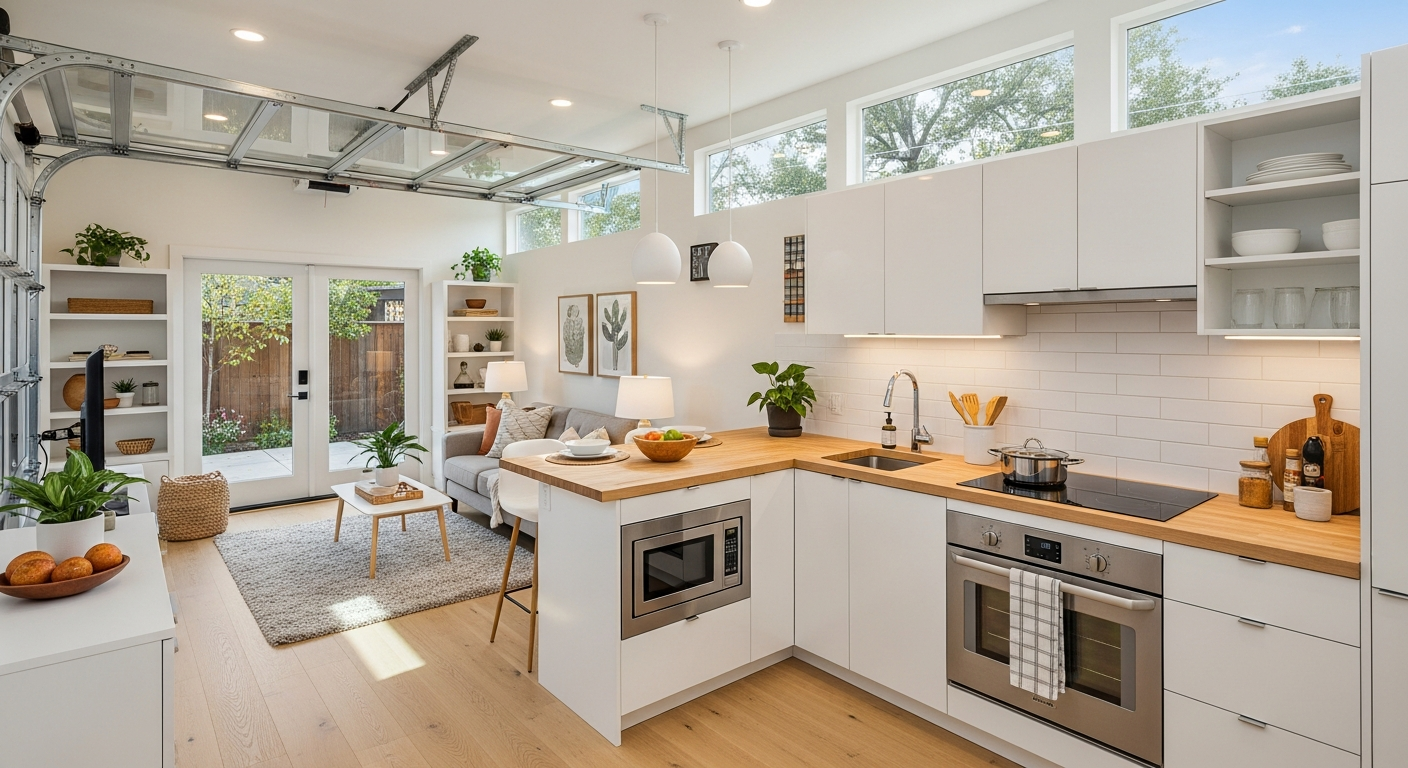
A junior accessory dwelling unit (JADU) is a small living space created within the walls of an existing single-family home, including attached garages. JADUs are an attractive option for many homeowners because they:
- Require less construction: Built within existing space rather than new construction.
- Cost less: Typically $50,000–$150,000 compared to $150,000–$400,000+ for detached ADUs.
- Have faster permitting: Simpler projects mean quicker approvals.
- Can share facilities: May share a bathroom with the main home, reducing costs.
- Avoid setback issues: No new building footprint means no setback concerns.
Under California law, JADUs must:
- Be no more than 500 square feet.
- Be built within an existing or proposed single-family residence (including attached garages).
- Have a separate entrance from the main home.
- Include an efficiency kitchen with cooking facilities, food prep counter, and storage cabinets.
What LA County Permit Data Reveals About JADU Adoption
Before exploring the specific policy changes under AB 1154 JADU California law, it's worth understanding the real-world adoption picture.
An analysis of LA County public permitting records shows that JADU applications have grown rapidly but still represent a small fraction of overall ADU activity.
Year-by-Year JADU Permit Trend in LA County
| Year | JADU Permits Filed |
|---|---|
| Pre-2020 | 0 |
| 2020 | 20 |
| 2021 | 65 |
| 2022 | 137 |
| 2023 | 137 |
| 2024 | 145 |
| 2025 (to date) | 97 |
| Total | 601 |
Key takeaways from the data:
- 601 JADU permits have been filed across LA County, all since 2020.
- JADU filings were nonexistent before 2020 and ramped to approximately 137 per year by 2022–2023.
- JADUs represent only 3–4% of all ADU-related applications, meaning the vast majority of homeowners who could build a JADU haven't yet explored the option.
- The steady growth trajectory validates the intent behind AB 1154: when junior ADU rules are clearer and more accessible, more homeowners act.
This data tells an important story. JADU adoption is real, measurable, and accelerating, but the 3–4% share of total applications signals that regulatory confusion has held the category back. AB 1154 directly targets that friction.
Key Changes Under AB 1154
1. Clarified Definitions
AB 1154 eliminates confusion between JADUs and small ADUs by creating clearer distinctions and ensuring that similar-sized units receive consistent treatment. Homeowners now have a more predictable path to approval regardless of whether they're building a JADU or a small attached ADU.
2. Unified Standards for Units Under 500 Square Feet
Previously, a 450-square-foot unit might face different requirements depending on how it was classified. AB 1154 creates more consistent standards for all small units, reducing the arbitrary differences that led to project delays and denials.
Our guide on ADU size rules explains in detail both the minimum and maximum sizes currently allowed.
3. Reduced Owner-Occupancy Restrictions
Under AB 1154, owner-occupancy requirements are more limited:
- If your JADU has its own separate bathroom, owner-occupancy cannot be required.
- Owner-occupancy may only be required when the JADU shares sanitation facilities with the main home.
- Even when required, the owner can live in either the main home OR the JADU.
This change provides significantly more flexibility for property owners who may want to rent out both units or live elsewhere.
4. Streamlined Permitting
By eliminating ambiguity in the junior ADU rules, AB 1154 helps local agencies process JADU and small ADU applications more efficiently. When rules are clear, permit reviewers can make faster decisions with greater confidence.
The permit data backs this up. JADU filings rose from zero to 137 per year once California's statewide ADU framework gave the category clearer footing, and AB 1154 is expected to accelerate that pace further.
Why JADUs Matter for California's Housing Crisis
California needs approximately 2.5 million new housing units to address its housing shortage. JADUs are a critical part of the solution because they:
Create Affordable Housing Naturally
JADUs typically rent for less than larger ADUs or apartments because they're smaller. This creates naturally affordable housing without requiring subsidies or income restrictions.
Work on Properties Where Detached ADUs Can't
Many California lots are too small or have setback issues that prevent construction of a detached ADU. JADUs, built within existing structures, avoid these constraints.
With 601 JADU permits already filed in LA County alone, with that figure representing just 3–4% of all ADU applications, the untapped potential is substantial.
Require Lower Investment
The lower cost of JADU construction makes them accessible to more homeowners, including those who couldn't afford a $300,000+ detached ADU project.
Add Housing Without Changing Neighborhoods
Because JADUs are contained within existing structures, they add housing without visually changing the character of single-family neighborhoods, addressing a common concern about ADU construction.
JADU Adoption Is Growing, and AB 1154 Will Push It Further
The growth from zero JADU permits before 2020 to roughly 137 per year by 2022–2023 proves that homeowners respond when junior ADU rules are accessible.
AB 1154 JADU California legislation removes another layer of regulatory friction, which means the 3–4% application share is likely to grow significantly as awareness increases and local agencies adjust their processes.
Who Benefits From AB 1154?
Homeowners With Attached Garages
Converting an attached garage to a JADU is one of the most cost-effective ways to add rental income to your property. AB 1154 makes this process clearer and faster.
Homeowners With Unused Interior Space
Large homes with underutilized rooms, basements, or bonus spaces are prime candidates for JADU conversion. The new law ensures these projects won't get caught up in regulatory confusion.
Property Investors
The relaxed owner-occupancy requirements make JADUs more attractive for investment properties. Owners can now rent both the main home and the JADU in more circumstances.
Family Housing Situations
JADUs are perfect for multigenerational living, creating space for aging parents, adult children, or other family members while maintaining privacy and independence.
JADU vs. ADU: Which Is Right for You?
| Feature | JADU | Detached ADU |
|---|---|---|
| Maximum Size | 500 sq. ft. | 800–1,200 sq. ft. |
| Location | Within existing home | Separate structure |
| Typical Cost | $50,000–$150,000 | $150,000–$400,000+ |
| Construction Time | 2–4 months | 6–12 months |
| Permit Timeline | 30–60 days | 60–90 days |
| Rental Income | $1,000–$2,000/mo | $2,000–$3,500/mo |
| Separate Bathroom | Optional | Required |
| Separate Entrance | Required | Required |
LA County permit data adds useful context to this comparison: JADUs account for just 3–4% of all ADU applications, but their adoption has grown from zero pre-2020 to 137 per year by 2022–2023.
That growth trajectory, combined with the lower cost and simpler permitting, suggests JADUs are increasingly being recognized as a viable path for homeowners who want to add housing without the complexity and expense of a detached build.
Choose a JADU if:
- You want to minimize cost and construction time.
- You have suitable space within your existing home.
- You want to add modest rental income.
- Your property has setback or lot coverage constraints.
Choose a detached ADU if:
- You want to maximize rental income.
- You prefer complete separation between units.
- You have adequate lot space.
- You want a larger unit for long-term rental or family use.
How To Get Started With a JADU
1. Assess Your Space
Walk through your home and attached garage to identify potential JADU locations. Look for spaces that:
- Have or can have exterior access.
- Are at least 220 square feet (minimum for efficiency units).
- Can accommodate an efficiency kitchen.
- Have or can have adequate natural light and ventilation.
2. Check Local Requirements
While state law sets minimum standards, your city may have additional requirements. Use LADU's Property Lookup tool to see if your property qualifies for an ADU. Contact your local planning department to understand:
- Local JADU ordinances.
- Permit fees and processing times.
- Any design standards that apply.
- Whether pre-approved plans are available.
3. Plan Your Budget
Budget for:
- Architectural/design fees: $2,000–$8,000
- Permit fees: $500–$3,000
- Construction costs: $40,000–$120,000
- Kitchen installation: $5,000–$20,000
- Bathroom (if adding separate): $10,000–$25,000
4. Work With Experienced Professionals
JADUs may seem simple, but proper design and construction are essential for:
- Meeting building codes.
- Maximizing the usable space.
- Creating an appealing rental unit.
- Ensuring long-term durability.
The Bottom Line
AB 1154 represents California's continued commitment to making ADU and JADU construction easier for homeowners. By clarifying junior ADU rules and removing unnecessary barriers, the law helps property owners create much-needed housing while generating rental income.
The numbers tell the story: 601 JADU permits filed in LA County, growth from zero before 2020 to 137 per year by 2022–2023, and a current share of just 3–4% of all ADU applications. The demand is real, the trend is clear, and AB 1154 is designed to unlock the next wave of JADU adoption.
Whether you're looking to house a family member, generate passive income, or simply make better use of your property, a JADU may be the perfect solution, and AB 1154 makes it easier than ever to build one.
How LADU Can Help
At LADU, we specialize in helping California homeowners navigate the ADU and JADU construction process from start to finish. Our team can help you evaluate whether a JADU or an ADU is right for your property.
Our ADU Design Services will design a unit that maximizes space and rental potential. We'll handle the entire ADU permitting process for you and guarantee approval. Our ADU construction partners will construct a high-quality unit that meets all code requirements and stays on schedule until completion.
Contact us or schedule a free consultation to learn more about building an ADU on your property.
Frequently Asked Questions
What is AB 1154 and how does it affect JADUs in California?
AB 1154 is a California law signed in October 2025 that clarifies and unifies the rules for junior accessory dwelling units (JADUs) and small ADUs under 500 square feet. It eliminates conflicting definitions, reduces owner-occupancy restrictions, and streamlines permitting, making it easier and faster for homeowners to build a JADU.
What is the difference between a JADU and an ADU?
A JADU (junior accessory dwelling unit) is built within the existing walls of a single-family home or attached garage and is limited to 500 square feet. A standard ADU can be a detached structure up to 800–1,200 square feet. JADUs cost less ($50,000–$150,000 vs. $150,000–$400,000+) and permit faster, but they generate lower rental income.
Do I have to live on my property to build a JADU?
Under AB 1154, owner-occupancy can only be required when a JADU shares sanitation facilities with the main home. If the JADU has its own bathroom, no owner-occupancy requirement can be imposed. Even when required, you can live in either the main home or the JADU.
How many JADU permits have been filed in LA County?
According to LA County public permitting records, 601 JADU permits have been filed countywide. JADU filings were nonexistent before 2020 and have ramped to approximately 137 per year by 2022–2023.
What percentage of ADU applications are JADUs?
JADUs represent approximately 3–4% of all ADU-related applications in LA County. This low share, despite strong growth, suggests that many homeowners who could build a JADU have not yet explored the option, a gap that AB 1154 aims to close by clarifying junior ADU rules.
Is JADU construction actually increasing in California?
Yes. LA County permit data shows JADU adoption growing steadily from zero permits before 2020 to roughly 137 per year by 2022–2023, totaling 601 permits to date. This growth validates the intent behind AB 1154 JADU California legislation: when junior ADU rules are clearer, more homeowners take action.
Contact us or schedule a free consultation to learn more about building an ADU on your property.