
A second home in your backyard,
from
$180k
The LADU 600 sqft prefab ADU is built off-site, delivered turnkey, managed end-to-end by LADU.
Choose the size that fits your lot
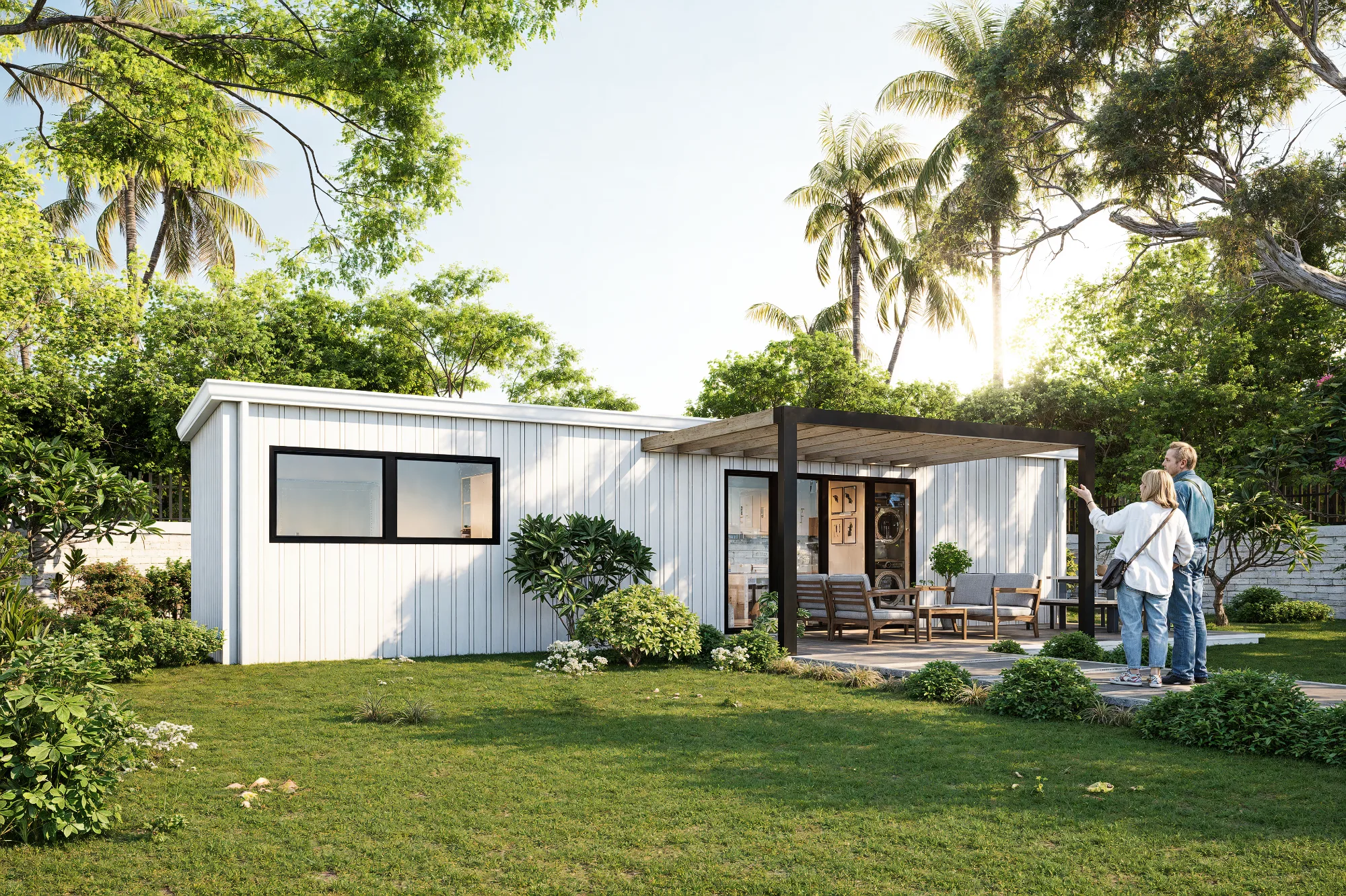
480 sq ft Model
Features
A finished home. Not a shell.
Most "starting price" quotes hide the extras. Ours doesn't. Every prefab ADU by ARCbuild × LADU includes:
Turnkey prefab home
Prefabricated, engineered, delivered ready to live in.
- 600 sqft conditioned space
- Customizable finishes to meet your style and budget
- W/D hookup or in-unit stackable
Permits & design
We handle every page of paperwork and every inspection.
- Architectural drawings & structural engineering
- Full city permit submission & approvals
- Zoning, setback, & easement review
- Title-24 compliance
- Final occupancy certificate
Site work & install
Foundation, utilities, crane, and finish — handled.
- Foundation & anchoring
- Utility trenching (water, sewer, electric)
- Crane delivery & set
- Exterior finish & landscaping cleanup
- 10-year structural warranty
From handshake to housewarming in one season
Traditional ADUs take 12-18 months. Because ARCbuild builds the home in a factory while LADU handles your lot, we get you to move-in in ~4-6 months after permits are approved.
Free site visit
We walk your lot, confirm feasibility, and lock your price.
Permits filed
Our in-house permit team submits same week. Permits typically take 90 days to approve, depending on your city and county.
Factory + foundation
Your site is prepped while the factory builds the home. Then the home is delivered and assembled on your site by a licensed contractor.
Delivery & keys
Final inspection and occupancy certificate. You're holding keys in one day.
Why homeowners are switching to prefab
Same permits, same quality, same square footage. Different math.
Modern design without the wait.
See if a prefab ADU works on your lot.
One of our project managers will walk your property, confirm feasibility, and give you a locked all-in price.
Book a Free Prefab ADU Consult- Free site visit — no obligation
- Locked price, zero surprise add-ons
- ~4-6 month move-in from permit approval
- 10-year structural warranty
Questions we get on every site visit
Is $180k really the all-in price?
$180k covers the turnkey home plus standard site work on a clear, flat lot with utilities at the property line. Lots with slope, mature trees, or long utility runs add cost — we tell you the exact number during your free site visit, before you sign anything.
No change-orders, no surprise add-ons. If the price changes mid-build because we missed something, we eat it.
Does my lot actually qualify for an ADU?
California state law allows an ADU on virtually every single-family lot, and most multi-family lots too. Our permit team knows the LA Municipal Code by heart and has landed permit approvals on 100% of our submissions.
Schedule a free site visit and we'll give you a straight yes or no within 48 hours.
How is this different from a regular ADU?
A traditional ADU is built piece-by-piece on your lot over 12-18 months — exposed to weather, scheduling delays, and change-orders. ARCbuild's ADU is engineered in a factory in parallel with your permits and foundation work, then delivered as a finished home in ~6 months.
Same building code. Same permits. Same warranty. Faster, cheaper, more certain.
Can I finance it?
Yes, once a prefab home is installed, you can finance it through conventional methods, like a mortgage.
We partner with lenders that offer ADU-specific construction loans. We'll introduce you to two or three options at your site visit. You pick.
How much customization is possible for ARCbuild homes?
Structurally, ARCbuild homes are similar to ordering a car – you can change the colors, the finish, the engine size and some of the options, but you can't change the wheelbase, or the location of the engine. Here are some general rules:
- We have several predesigned models and floor plans that speed things up in terms of production, submission to the various local and state agencies, inspections and delivery. However, we can also work with you to adapt your desired floor plan to meet the rigorous requirements of prefab engineering.
- Once we arrive at a plan that works, we can work with you to discuss customization. We will provide a detailed fit-out sheet that describes the standard options in your home. Most customizations will involve interior and exterior finish, flooring, fixtures, lighting, windows, doors, cabinets, counters, appliances and the possible integration of clean tech.
How much rent can I expect?
In LA, 1BR 600 sqft ADUs typically rent for $2,400-$2,900/mo; 2BR for $3,100-$3,700/mo. Your exact number depends on neighborhood — we'll pull comparable rentals within a half-mile of your lot at the site visit.
What is a prefab home?
Simply put, a prefab home is a home built using prefab construction. Prefab construction occurs off-site and inside a facility rather than at the property where the home will be permanently located. Sections of the home, known as modules, are constructed inside the facility and then transported to the property and assembled. Once the modules are assembled, a prefab home looks like any other house.
Prefab homes are different from manufactured homes (sometimes called mobile homes). Manufactured homes are built on a permanent steel frame and moved using wheels and axles on that steel frame. Because the steel frame is integral to its construction, a manufactured home can be moved to another location. Unlike manufactured homes, a home built with prefab construction is transported on a carrier. Once it is on the property, it is moved off the carrier onto a foundation and assembled. The home becomes permanent to the property.
What are the advantages of prefab homes?
Prefab homes are built to the same building codes as a site-built home. The advantage is that portions of the home, called modules, are built inside a facility and protected from the elements during the building process. No dealing with inclement weather. But that is just one advantage to building prefab. Because the modules are delivered to your site on carriers, they are built to withstand transportation over a variety of roadways. Adding to this the stringent quality controls during construction, prefab homes become much more durable and resilient than site-constructed houses.
Because the process is streamlined, prefab homes typically cost less than a comparable site-built home and appraise at the same level as a site-built home. Despite this fact, they can still be financed through conventional means, making it possible to use the most profitable funding option available.
So generally, with prefab homes, you get the same quality as a site-built home that's built faster, at less cost but with the same value.
Do prefab homes appreciate in value?
Yes! Prefab homes appreciate similarly to traditional, site-built homes. They are appraised using the same standards, and in some cases, we see the market valuing them even higher. This is due to the reliable consistency, durability, and energy efficiencies that factory-built homes offer.
Can prefab homes be moved?
Unlike manufactured homes (often called mobile homes), a prefab home cannot be moved. Once it is transported and removed from the carrier, it becomes permanent for the property, just like a standard site-built home.
Do you have two-story models?
Yes. ARCbuild homes can be one- or two-stories with engineering and design plans underway for a third floor in the near future.
How much finishing work is required once my prefab home is delivered?
Using rigorous prefab construction, ARCbuild homes are delivered to the site 80% complete. However, there is still about 20% of the finish work that needs to be completed once the home is set. This work includes finish work on the drywall, flooring, and ceiling areas where the modules come together, as well as setting doors or installing countertops that might start in one module but flow into another. On the exterior of the home, siding and shingles will need to be integrated between the modules. Also, the home's plumbing, electrical and HVAC systems will need to be completed on site and connected accordingly.
What type of warranty comes with a prefab home?
ARCbuild homes are backed by a comprehensive 1-year manufacturer's warranty, providing full coverage against workmanship & material defects, a 10-year warranty against structural defects, and 4 years for plumbing and electrical systems. In addition to this, certain brand-name products integrated into our homes may carry their own extended warranties, surpassing the manufacturer's standard coverage. Notably, items such as windows, shingles, and cabinets often come with longer warranties, enhancing the overall protection and durability of your new home.
How long do prefab homes last?
ARCbuild homes differ very little from site-constructed homes when placed on a property, as they also become permanently bound to it. This means that they can last as long as a standard site-built home, though often they are even more durable. This is because they undergo stricter quality control throughout different stages of construction.
Prefab homes are also better suited to withstand natural disasters, including hurricanes, tornadoes, storms, and earthquakes (ARCbuild homes are also fire defensible based on the use of non-combustible materials). In addition to materials, prefab homes are stronger due to the frequent and stringent quality controls employed during the manufacturing process. It's not possible to say how long a prefab home will last. An average traditional home can endure for 50 to 100 years. Prefab homes are expected to meet and exceed this spec.
How do prefab homes hold up during hurricanes, earthquakes, fires, and other severe weather conditions?
Research shows homes built with prefab construction fare even better than a traditionally built home under extreme weather conditions like hurricanes and earthquakes. After Hurricane Andrew in 1992, FEMA commissioned a study comparing site-built homes to both manufactured and prefab homes. In their report, called Building Performance: Hurricane Andrew in Florida, FEMA concluded that prefab homes withstood the storm "far better" than site-built housing. "Overall," the report stated, "relatively minimal structural damage was noted in prefab housing developments. The module-to-module combination of the units appears to have provided an inherently rigid system that performed much better than conventional residential framing. This was evident in both the transverse and longitudinal directions of the prefab buildings," according to the report (Publication number FIA-22, item 3-0180).
See if a prefab ADU works on your lot.
One of our project managers will walk your property, confirm feasibility, and give you a locked all-in price.
Book a Free Prefab ADU Consult- Free site visit — no obligation
- Locked price, zero surprise add-ons
- ~4-6 month move-in from permit approval
- 10-year structural warranty