Ask Your AI Assistant About Your ADU - LADU Launches a Public MCP Server
LADU's new Model Context Protocol (MCP) server lets AI assistants like Claude and Cursor answer ADU questions with real LA County data — buildability checks, city rules, cost estimates, and 19,000+ permit records.
Ask Your AI Assistant About Your ADU
More and more homeowners start an ADU project the same way they start everything else now: by asking an AI assistant. "Can I build an ADU at my address?" "How much does an ADU cost in Pasadena?" "How many ADUs were permitted in LA County last year?"
The problem is that general-purpose AI models don't have reliable, current, Los-Angeles-specific answers to those questions. They guess, they generalize, and sometimes they're confidently wrong about the rules that decide whether your project is even possible.
So we built something to fix that. LADU now runs a public Model Context Protocol (MCP) server that connects AI assistants directly to our ADU data — the same data that powers LADU's property lookup and cost calculator, plus 19,000+ LA County ADU permit records.
What is an MCP server, in plain English?
The Model Context Protocol is an open standard that lets AI assistants call external tools and data sources. Instead of relying on whatever a model happened to memorize during training, an MCP-connected assistant can fetch a live, sourced answer from a system that actually knows.
Think of it as giving your AI assistant a direct line to LADU's database. When you ask it an ADU question, it can look up the real answer instead of estimating one.
What you can ask
Once LADU's server is connected, an AI assistant can answer questions like these with real data:
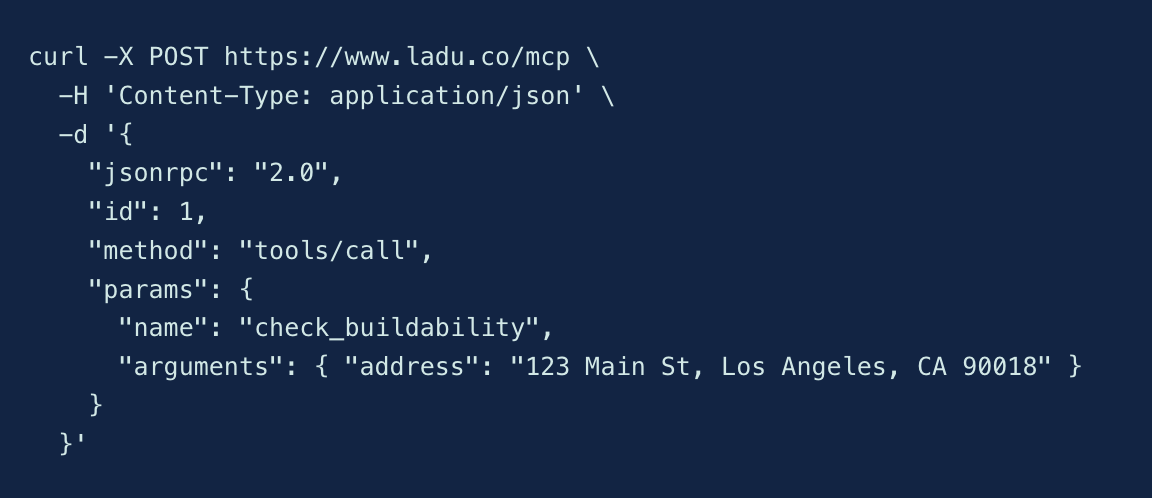
- "Can I build an ADU at 123 Main St?" — returns a plain-English buildability verdict, the parcel's zoning and any regulatory overlays (hillside, coastal, fire, flood, historic, fault zones), and the ADU rules that apply.
- "What are the ADU setback and size rules in Santa Monica?" — returns the city's setbacks, maximum size, height limits, parking requirements, permit fees, and timeline.
- "How does Pasadena compare to Burbank for ADUs?" — returns a side-by-side comparison of the two cities' rules.
- "How many ADUs were permitted in LA County in 2025, and what's the trend?" — returns year-by-year permit counts and median valuations.
- "What's a typical ADU permit valuation in my area?" — returns the 25th percentile, median, and 75th percentile of declared permit valuations.
- "Are people building ADUs near this address?" — returns recent permitted ADUs within a radius.
Every answer comes with its data source, so the assistant can cite where the numbers came from.
How to connect it
The server is free, read-only, and needs no signup. If you use an MCP-compatible assistant like Claude Desktop or Cursor, add this to your MCP configuration:
{
  "mcpServers": {
    "ladu": {
      "url": "https://www.ladu.co/mcp"
    }
  }
}
That's it. Full setup details and the complete list of tools are on the LADU MCP Server page.
Built on real, public LA County data
The numbers behind the server come from public LA County Assessor and LA City and County Building & Safety records, going back to 2018 and deduplicated by case number so counts reflect real projects rather than duplicate revision filings. You can read exactly how we collect and clean the data in our data methodology.
A note on responsible use: the server is deliberately limited. It returns property characteristics, regulations, and aggregate permit statistics — and never owner names, contact information, or financial details. It runs against a least-privilege, read-only database connection so private information simply isn't reachable.
Why we built it
ADU rules in Los Angeles are genuinely complicated, they change often, and the answers depend on the specific parcel. That's exactly the kind of question people increasingly bring to AI assistants — and exactly the kind of question those assistants tend to get wrong without good data behind them.
We'd rather AI tools give homeowners accurate, sourced answers about what's possible on their property. Making LADU's data available through an open standard is the most direct way to do that.
If you're exploring an ADU and want a real person to walk through your options, schedule a free consultation or look up your property to see what's possible at your address right now.
Contact us or schedule a free consultation to learn more about building an ADU on your property.