If you are planning to build an accessory dwelling unit (ADU) in California, one of the first things you need to understand is setback requirements.
Setbacks determine how close your ADU can be placed to property lines, and California state law sets clear limits on what local agencies can require.
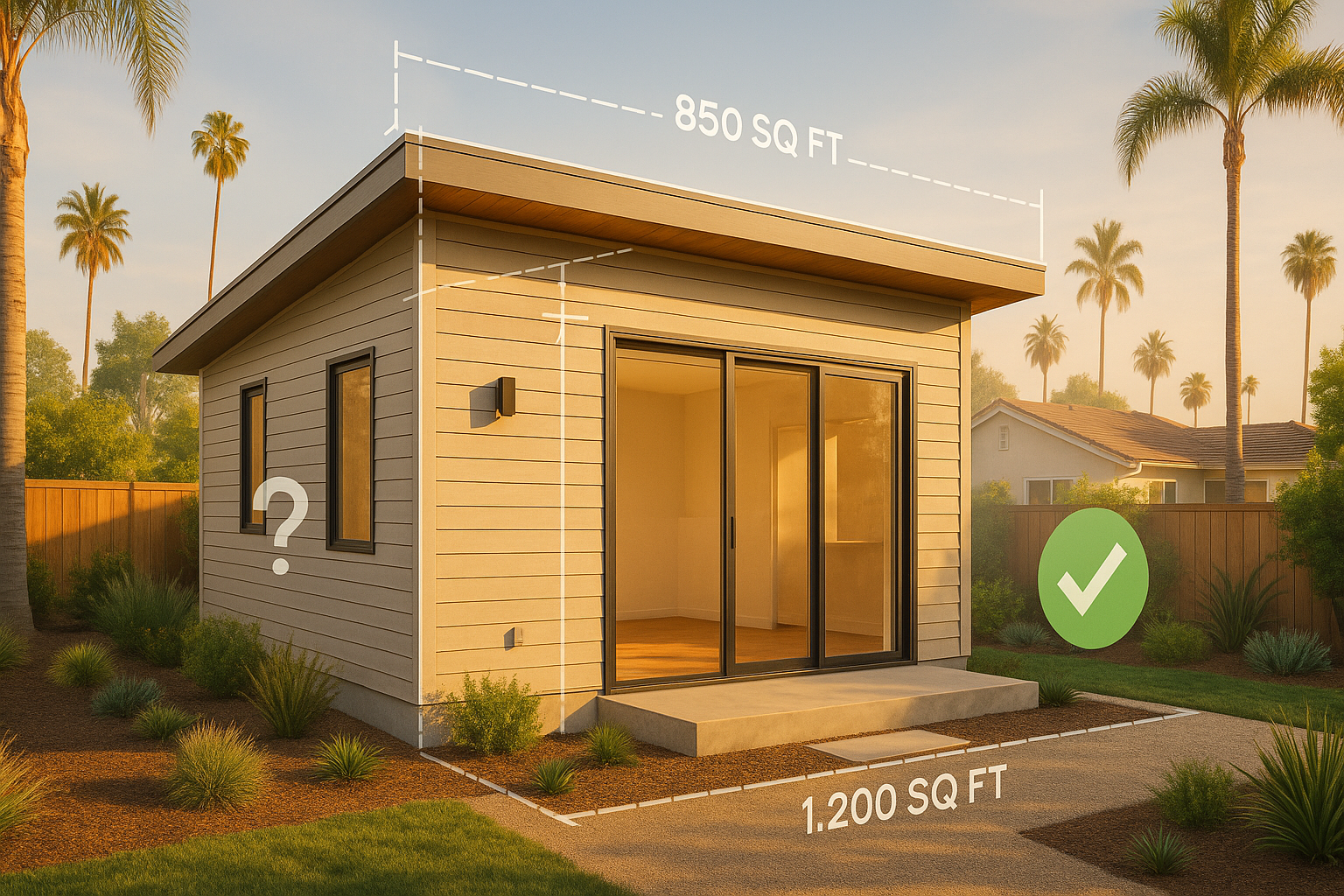
Under current California law, local agencies cannot impose side or rear yard setbacks greater than 4 feet for most detached ADUs. This statewide standard applies across all California cities and counties, giving homeowners predictable rules regardless of local zoning.
This guide covers every setback scenario you are likely to encounter, including detached ADUs, attached ADUs, garage conversions, JADUs, and multifamily lots.
Ready to start planning your new ADU? When you choose LADU, you're choosing an architect-led ADU company backed by experience and expertise.
We'll streamline your entire ADU project from start to finish with one accountable team. From initial ADU design to the final inspection, we deliver expert service and dependable results with faster timelines and clear communication every step of the way.
Schedule your free site visit today or call (213) 855-3334 to speak with one of our ADU experts to start turning your vision into reality.
Understanding ADU Setbacks in California
A setback is the minimum distance required between the exterior wall of a structure and the nearest property line. Setback requirements exist primarily for fire safety, privacy, and maintaining reasonable spacing between buildings.
For ADUs, California's Government Code sections 66310 through 66342 (the consolidated ADU statutes effective January 2025) establish the statewide framework. These laws override local zoning codes that attempt to impose stricter setback requirements, with limited exceptions.
The California Department of Housing and Community Development (HCD) publishes the ADU Handbook, most recently updated in March 2026, which serves as the authoritative reference for interpreting these rules.
Setback requirements often determine how big an ADU can be, but with careful planning from day one, you can achieve plenty of square footage, even within a smaller footprint.
Detached ADU Setback Requirements
Detached ADUs are the most common type built in California, and the setback rules are straightforward.
ADU Side Setback: 4 Feet Maximum
Under Government Code section 66321, subdivision (b)(3), local agencies cannot require side yard setbacks greater than 4 feet for a detached ADU.
This means your ADU can be built as close as 4 feet from the side property line, even if local zoning normally requires a larger setback for other structures.
ADU Rear Setback: 4 Feet Maximum
The same 4-foot maximum applies to rear yard setbacks. Your detached ADU can sit four feet from the rear property line.
Front Setback: Determined by Local Zoning
California state law does not override local front setback requirements for ADUs. Front setbacks remain governed by your city or county's zoning code. In most residential zones, front setbacks range from 15 to 25 feet, though this varies significantly by jurisdiction.
ADU Setback From the Main House
State law does not specify a minimum distance between a detached ADU and the primary dwelling.
However, local building codes may require a separation for fire safety, typically 5 to 10 feet depending on construction type and fire ratings. Check with your local building department for the specific requirement in your area.
Height Limits for Detached ADUs
Height limits work alongside setback requirements and were significantly updated by SB 897 (2022). The current rules create a tiered system:
- 16 feet: Base height limit for detached ADUs on single-family lots
- 18 feet: Allowed on multifamily lots
- 20 feet: Allowed within one-half mile of a major transit stop or high-quality transit corridor
- 25 feet: Allowed for ADUs built above an existing or new garage within one-half mile of transit
These height limits apply regardless of what local zoning allows for other structures. If your lot is near transit, you gain meaningful additional height that can make two-story ADU designs feasible.
Attached ADU Setback Requirements
Attached ADUs are built as additions to the primary dwelling. Their setback requirements depend on the specific situation.
If the attached ADU qualifies under the streamlined state standards (Government Code section 66323), the 4-foot side and rear setback maximums apply.
If the attached ADU is processed under local ADU ordinances that follow the general standards in Government Code section 66321, the local agency may apply the same setbacks as the primary dwelling.
In practice, most attached ADUs in California benefit from the 4-foot standard because state law takes precedence when local rules are more restrictive.
Attached ADUs can be up to 1,200 square feet or 50% of the primary dwelling's living area, whichever is less, depending on local standards and the specific Government Code provision being applied.
Garage Conversion ADU Setbacks
Converting an existing garage into an ADU is one of the most straightforward paths because the structure already exists.
Under Government Code section 66323, subdivision (a)(1), garage conversions that stay within the existing building footprint do not need to meet current setback requirements.
If your garage is 2 feet from the property line, you can convert it into an ADU without modifying the structure to achieve a 4-foot setback.
This exception also applies to other existing accessory structures such as workshops and storage buildings. The key requirement is that the conversion stays within the existing footprint.
Garage conversions are eligible for a 150-square-foot expansion beyond the existing footprint to accommodate ingress and egress. The expanded portion must meet applicable setback and building code requirements.
JADU Setback Requirements
A Junior ADU (JADU) is an ADU of 500 square feet or less built within the existing footprint of a single-family home or accessory structure.
Because JADUs do not extend beyond the existing building envelope, they have no additional setback requirements beyond fire and safety clearances.
JADUs must have a separate exterior entrance, but this does not change the setback equation as long as the entrance does not extend the building's footprint into a setback area.
One JADU is permitted per single-family lot in addition to a standard ADU, which means you can have both a JADU inside the house and a detached ADU in the backyard.
Multifamily Lot ADU Setbacks
ADUs on lots with existing multifamily dwellings (duplexes, triplexes, apartment buildings, etc.) follow similar 4-foot side and rear setback rules under Government Code section 66323, subdivision (a)(4).
Local agencies must allow at least two detached ADUs on multifamily lots, with the same 4-foot setback standard. Height limits of 16 to 20 feet apply depending on lot conditions and transit proximity.
An additional provision states that local agencies cannot require a property owner to modify setbacks on an existing multifamily building that already has setbacks less than 4 feet as a condition of approving a new ADU on the lot.
The 800 Square Foot Protection
California law includes an important safeguard: local agencies cannot impose setback, lot coverage, floor area ratio (FAR), or open space requirements that would prevent a homeowner from building at least an 800-square-foot ADU on their property.
This means that even if strict setback compliance on your lot would leave insufficient room for an ADU, the state's 800-square-foot minimum protection ensures you still have a path forward.
Local agencies must approve an ADU of at least 800 square feet with 4-foot setbacks, regardless of other zoning constraints.
Practical Tips for ADU Placement
Get a property survey before starting design. Accurate property line locations are essential for setback compliance. Fences do not always sit on true property lines, and even small measurement errors can cause permitting problems and impact your construction timeline.
Work setbacks into your design early. Knowing you have 4 feet on the sides and rear, plus whatever front setback applies, defines your buildable envelope. Share this information with your designer from day one.
Consider eave and overhang dimensions. Some jurisdictions measure setbacks from the roof overhang rather than the wall. Clarify this with your local building department before finalizing plans.
Check for overlay zones. Coastal zones, hillside areas, historic districts, and wildfire hazard zones may impose additional setback or development requirements that layer on top of the state ADU standards.
ADU permits in California are ministerial approvals, meaning the city or county cannot apply discretionary review or subjective design standards to your project. If your plans meet the objective setback and development standards, the permit must be approved.
Design Smarter Within the 4-Foot Rule
Setbacks don't just limit your ADU; they define your opportunity. When you understand how to work within California's 4-foot standard, you can design layouts, plan orientations, and build strategies that maximize space without triggering delays.
The most successful projects treat setbacks as a design framework, not a constraint, using smart placement to improve privacy, light, and long-term usability.
LADU helps you translate these rules into a buildable, optimized plan. Schedule your free site visit or call (213) 855-3334 to get started.
Frequently Asked Questions
What is the minimum setback for a detached ADU in California?
The minimum setback for a California ADU is 4 feet from side and rear property lines under state law. Local agencies cannot require more than 4 feet.
Do garage conversions need to meet setback requirements?
No, garage conversions do not need to meet setback requirements for the existing footprint. If the garage is already built closer than 4 feet to a property line, it can be converted without modifying setbacks. Expansions beyond the existing footprint must meet applicable setbacks.
Can my city require setbacks greater than four feet?
For detached ADUs processed under the streamlined state standards, no. However, front setbacks are still determined by local zoning, and overlay zones may add requirements in specific areas.
How far does an ADU need to be from the main house?
State law does not specify a minimum distance from the primary dwelling. Local building codes may require a fire separation of 5 to 10 feet depending on construction type.
Do I need a variance if my lot is tight?
Typically no. California law guarantees the right to build at least an 800-square-foot ADU with 4-foot setbacks, even if other zoning rules would otherwise restrict the buildable area.
What is the maximum height for a detached ADU?
The base limit is 16 feet, increasing to 18, 20, or 25 feet, depending on lot type and proximity to transit. SB 897 established these height tiers in 2022, and they apply statewide.
Contact us or schedule a free consultation to learn more about building an ADU on your property.